Journal
2026-08-25 · 5 minMen, women, unisex: labels versus taste
Gendered aisles are a marketing habit roughly a century old. What actually changes between them, and how to ask for a fragrance by taste instead.
Search still divides the way shelves divide: men's perfume, women's perfume, عطور رجالية, عطور نسائية. People do not. One walk through any shop is enough to see a woman buying something displayed in the men's section and a man finishing a bottle marketed entirely to women. The label is not a lie, but it is not a description of a smell either. It is an old marketing decision that has come to look like a law of nature.
Historically, sorting fragrance by gender is fairly recent. For centuries perfume was simply used by everyone without sections, and the most famous compositions of the nineteenth century were made with no clear line at all. Guerlain Jicky, launched in 1889, is usually cited as the first modern fragrance worn by men and women alike. The hard split arrived later, with mass advertising, when it became easier to sell the idea of a fragrance for him and a fragrance for her than to sell a smell.
Chemically the classification means nothing. Vanilla is not feminine, leather is not masculine, and rose has no idea who is wearing it. In this part of the world rose is a firmly established note in men's fragrance, while elsewhere it is usually placed in the women's aisle. Oud appears on both sides. What changes is not the molecule but the composition around it: the proportions, the level of sweetness, and whether a herbal or smoky material shifts the overall impression.
Look at three examples everyone knows. YSL Black Opium was built on coffee, vanilla and orange blossom and marketed to women, and it ends up on people who never appeared in any campaign. Valentino Born in Roma became a gift language in its own right, with two versions that are constantly bought by each side for the other. And YSL MYSLF sits in the men's aisle with its lavender, orange blossom and clean musk, then frequently leaves the shop as a present for someone who never read the brief.

That is where the word unisex comes from. It is partly a late admission rather than an invention: houses noticed that people were crossing the aisles, so they built a third aisle. The irony is that a great many fragrances currently classified as masculine or feminine could be worn by anyone with nothing changed at all. The classification serves the shelf, not the nose.
Much of what is assumed to be a difference between genders is really a difference between seasons. Heavy, sweet compositions get read as feminine when they are simply winter fragrances, and dry citrus ones get read as masculine when they are hot-weather fragrances. When someone says a scent does not suit a man, they usually mean it is heavier or sweeter than they are used to, not that it belongs to another sex. Swapping the word masculine for the word dry, or light, resolves half the misunderstandings on a shop floor.
A third factor is always forgotten: skin. The same perfume behaves differently from person to person according to oiliness, temperature and pH. A frankly feminine-marketed scent can read quiet and clean on one person and far too heavy on another. That alone is enough to retire the idea that a label describes a smell. The label describes a campaign; skin describes the result.
So what is the practical alternative? Describe rather than classify. Instead of asking for a men's fragrance, say you want something dry and woody, moderate in projection, for daytime, in hot weather. That sentence gives a seller real information and opens bottles you would never have looked at if you had obeyed the label. Four axes are usually enough: olfactory family, weight, occasion and season.
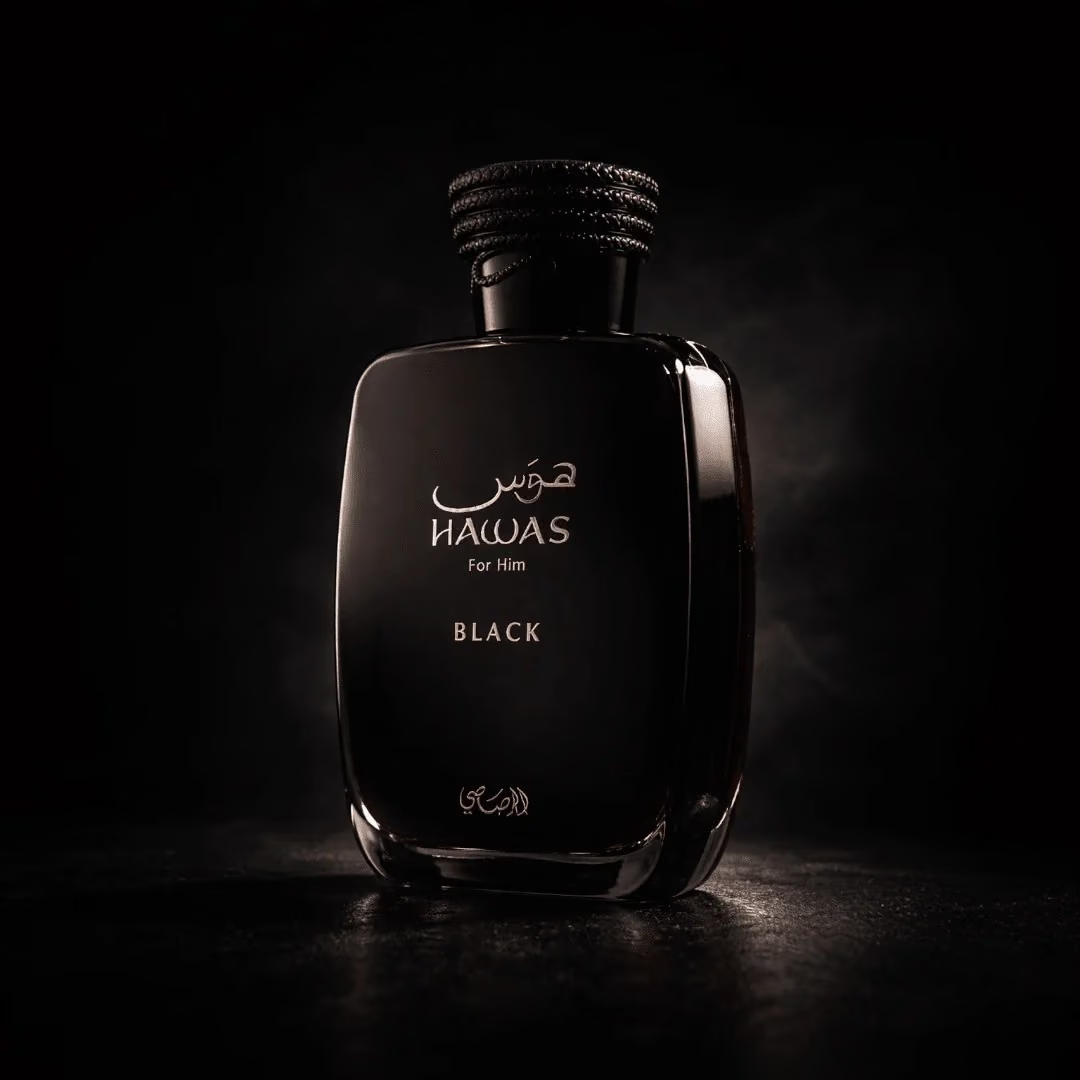
Gifting is where the label becomes a genuine trap. People buying a present choose from the section matching the recipient's gender and land on a fragrance unrelated to that person's taste. Better to ask what they wear now, or what smell they like in their home or on their clothes, and then look for something close to it in whatever section it happens to sit.
For anyone selling, the lesson is clearer still: arrange by family rather than by gender wherever possible, or at least let customers cross between sections without awkwardness. A lot of lost sales come down to nobody offering a woman something from the men's shelf. And if you want to check whether a fragrance is genuinely worn outside its classification, user pages on Fragrantica usually show who wears it and when, which is more honest than the carton.
Taste is wider than the shelf. There is a note on gifting perfume without a script, another on designer and niche, and the rest of the series in the journal.
We are a perfume trading company working from Dubai. If you want to describe your taste, or your customers', to someone who listens, Ahmad and Khaled are on WhatsApp, or use the contact form.