Journal
2026-08-29 · 4 minHow a bottle of perfume travels intact
Heat, light, air and impact are what a bottle actually faces between a warehouse and a dressing table — and how to pack, store and check for all four.
A bottle of perfume is a surprisingly delicate object pretending to be a solid one. It is a volatile solution of aromatic materials in alcohol, sealed behind a small mechanical pump, held in glass, inside a printed carton. Everything that happens to it between a warehouse and a dressing table is a test of those four layers, and most of what goes wrong stays invisible until somebody sprays it.
Heat is the first and worst enemy. Aromatic materials oxidise faster as temperature rises, and the light, bright molecules at the top of a composition — citrus oils, aldehydes, some green notes — degrade first. A bottle that spent a week in a hot vehicle or against a sun-facing wall does not usually smell broken. It smells slightly wrong: the opening is flatter, sometimes sour, and the balance the perfumer built has tilted a few degrees. Buyers describe this as "it smells fake" far more often than it deserves.
Light does its own damage. Ultraviolet exposure breaks aromatic molecules apart and darkens juice over time, which is why a clear untinted bottle is more vulnerable than a smoked or coloured one, and why the carton is not merely decoration. The box a shop throws away was doing a job.
Air is the slow one. As a bottle empties, the space above the liquid fills with air, and oxidation continues quietly for as long as the bottle exists. This is why spray bottles outlive splash bottles, why decanting into a cheap atomiser shortens a fragrance's life, and why a half-used bottle from three years ago is not quite the fragrance that was sold three years ago.
Then the mechanical side. Pumps weep when a bottle lies on its side under pressure. Caps work loose with vibration. The thin dip tube inside can crack. Glass is strong against even compression and weak against a corner impact, so a bottle can survive a heavy stack and die from one short drop onto an edge.
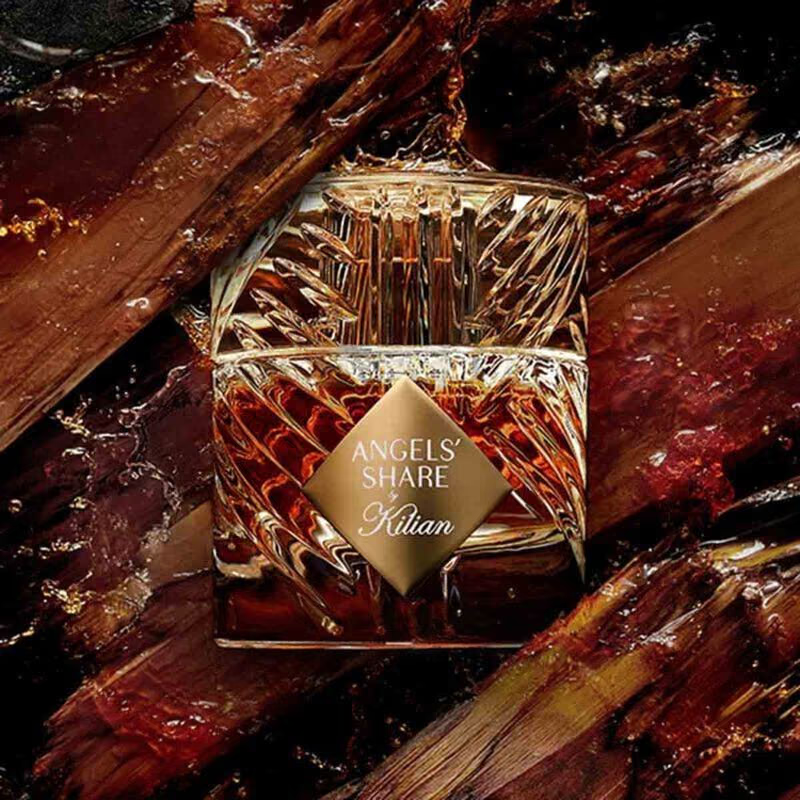
Good packing is therefore boring and specific. The original carton is structural: it holds the bottle centred and absorbs the first shock, which is why serious handlers do not strip it. Bottles should never touch each other, so cell dividers or individual wraps earn their cost. There should be no room to move inside an outer box, because movement turns a small knock into a broken shoulder. Void fill on all six faces, including underneath, protects more than any printed fragile symbol. And stacking has a limit — cartons at the bottom of a tall pallet carry weight nobody designed them for.
Where a bottle waits matters as much as how it moves. Storage against an external wall or under a metal roof can run far hotter than the room average, and a single afternoon can undo a careful month. A stable, dark, moderate space with some airflow protects fragrance better than an expensive climate promise nobody monitors. The same rule applies at home: a bathroom is a poor place for perfume because of the heat and humidity swings, and a windowsill is worse.
When a shipment arrives, a few checks take two minutes and settle most later arguments. Feel the temperature of the carton before you open it. Look at the cellophane and the carton edges. Check that the batch code on the box matches the one on the bottle, where the house prints both. Test one sprayer for a clean mist rather than a spit. Compare the colour of the juice against what you expect, and smell the opening — not to judge the fragrance, but to confirm that the top notes are still there. If something is wrong, say so immediately and in detail, because the story of a shipment is far easier to reconstruct on the first day than in the third week.
Arrived intact is a larger idea than arrived unbroken. A bottle can survive a journey perfectly as an object and arrive diminished as a fragrance, and only one of those two failures is visible in a photograph. Anyone who moves perfume for a living learns to think about the juice rather than the glass. There is more on the everyday version of this in heat and the life of a fragrance, and on inspecting what you receive in how to spot original perfume.
If you would rather discuss handling with a person than read a page about it, HH Perfumes is a company in Dubai — Ahmad and Khaled answer on WhatsApp or through the contact form.