Journal
2026-08-06 · 4 minWhen a fragrance gets hard to find
Scarcity in perfume behaves like weather. Harvests, regulation, flankers and sudden attention all move availability — and a second answer is worth more than a wait.
People treat scarcity in fragrance as if it were a judgement — as though a name being hard to find says something about its quality, or about whoever is failing to produce it. Most of the time scarcity is closer to weather. It has causes, it has seasons, and it passes.
Start with raw materials, because they move more slowly than anything else in the chain. Orris butter comes from iris rhizomes that are dug, dried and aged for years before processing, which puts a multi-year lag between a decision and a bottle. Vanilla has been through swings severe enough to reshape entire briefs. Sandalwood moved from wild harvest to plantation cycles measured in decades. Citrus is an agricultural crop with bad years. When a natural material tightens, a house does not simply absorb it — it reformulates, reduces, or produces less. None of that is visible from outside. You only notice that something has become harder to get.
Regulation moves on its own clock. Limits on certain materials — oakmoss at classic concentrations is the most cited example — have forced rebuilds of famous formulas. The result is usually not disappearance but change, which is a subtler kind of scarcity: the name is available, and the thing you remember is not.
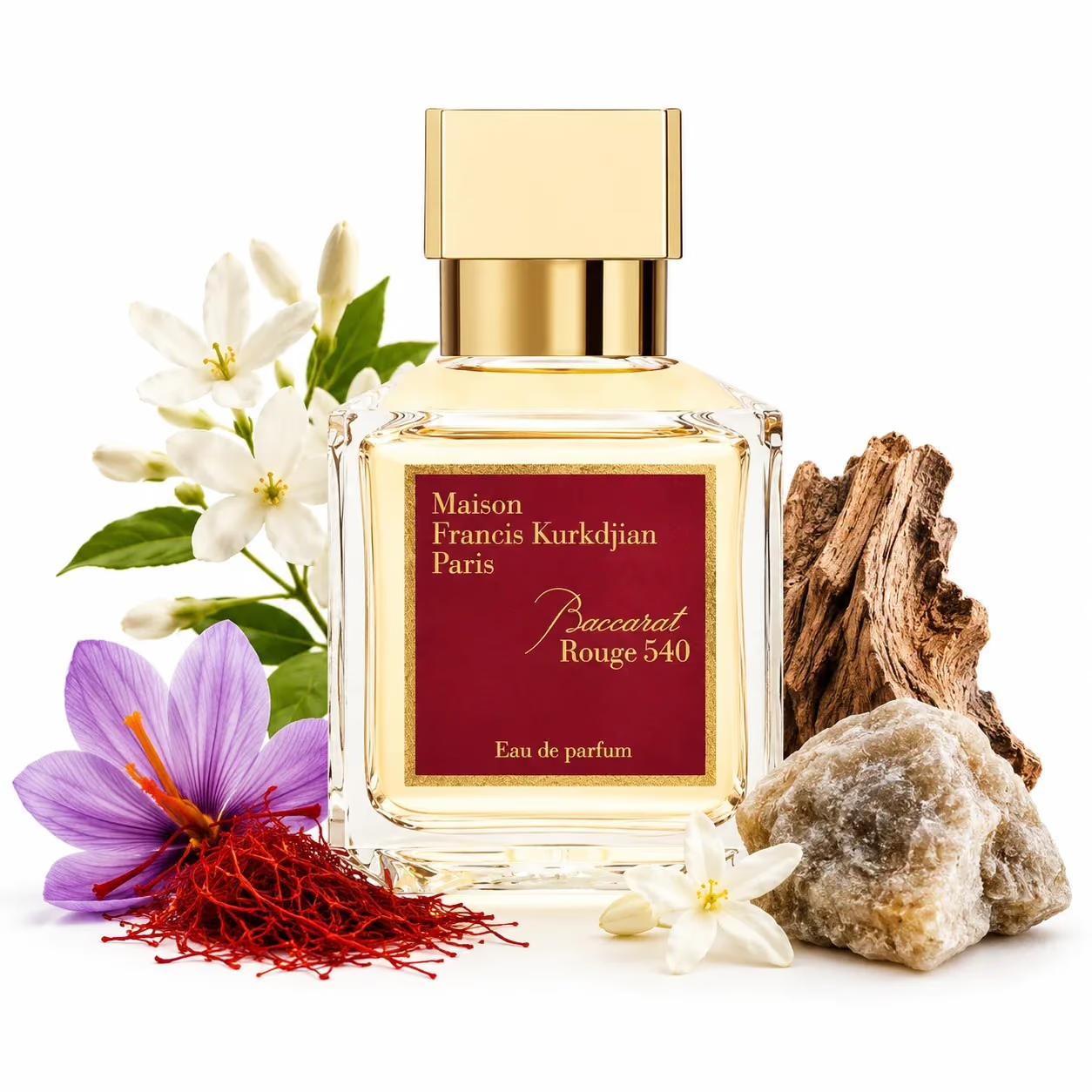
Then there is attention, the fastest force of all. Maison Francis Kurkdjian's Baccarat Rouge 540 is the modern case study. It launched in 2015 as an anniversary piece, built around saffron, jasmine, cedar and a woody-amber material that reads as sweet, mineral and deliberately synthetic. For a while it was a niche curiosity. Then it became a phenomenon — referenced in songs, adopted as an aesthetic, imitated into an entire genre. Demand of that shape does not arrive on a production schedule. Houses plan output on historical curves, and a viral curve is not historical.
Attention also produces flankers, which fragment supply further. An extrait, a body line, a summer edition: each is a separate production decision pulling the same name in a different direction. Ask for Baccarat Rouge today and the honest first reply is a question about which one you mean.
Distribution is the last layer and the most local. A reference can be perfectly ordinary in one place and awkward in another during the same month, for reasons as boring as a packaging revision or a paused run. From where a buyer stands, absence looks identical whether it is a discontinuation, a pause, or a shipment that has not landed. That is why a flat no is so often the wrong reading.
What follows is practical.
Have a second answer. If you can only describe what you want by one name, you have exactly one chance. If you can describe the family — a woody-amber with saffron and a sweet mineral finish, say — then a season of unavailability becomes an inconvenience instead of a dead end. This is the single most useful habit a buyer can build, and it is worth more than any contact list.
Ask about timing rather than existence. Is it gone is a question nobody can answer honestly. Is this a pause or a change, and roughly when does it come around again, is a question someone in the trade can often answer approximately — which is more than any webpage will ever do.
Be suspicious of urgency. Scarcity is the oldest lever in selling and also the easiest thing to fake. Real scarcity has a boring explanation behind it: a harvest, a rule, a factory calendar. Manufactured scarcity has a countdown.
And treat the version you remember as a variable. If you are chasing a bottle you loved eight years ago, part of what you are chasing is a formula and a batch, not only a name. Saying that out loud changes the answer you get.
Community archives are useful for the historical half of this. Basenotes carries long threads on reformulation and batch differences, and Fragrantica keeps launch years and flanker trees straight. Both are libraries, not availability feeds.
For how availability, heat and vocabulary interact, the neighbouring notes are in the journal. If you would rather describe what you are after and let somebody answer with a date attached, the contact page is open.