日志
2026-09-01 · 4 分钟The noses behind the bottles
Perfumes are written by people. Francis Kurkdjian, Olivier Cresp and Alberto Morillas explain how a brief, a budget and a nose become a bottle.
Almost nobody buys a perfume because of who made it, which is strange, because somebody did make it. Not a brand, not a mood board — a person, usually working in a laboratory belonging to one of a handful of fragrance and flavour companies, writing formulas in grams and revising them dozens of times against a brief written by a marketing department.
That is the first thing worth knowing about the industry. The great designer houses do not, as a rule, employ the perfumers whose work carries their name. Composition is largely done by Givaudan, Firmenich, IFF and Symrise, who compete for a brief and submit trials. A house describes what it wants — an audience, a season, a feeling, a budget — and several perfumers submit modifications until one wins. That structure explains why a perfumer’s career can include a supermarket bestseller and a rarefied niche composition in the same year, and why the credited name matters more than the logo if you want to predict what you will like.
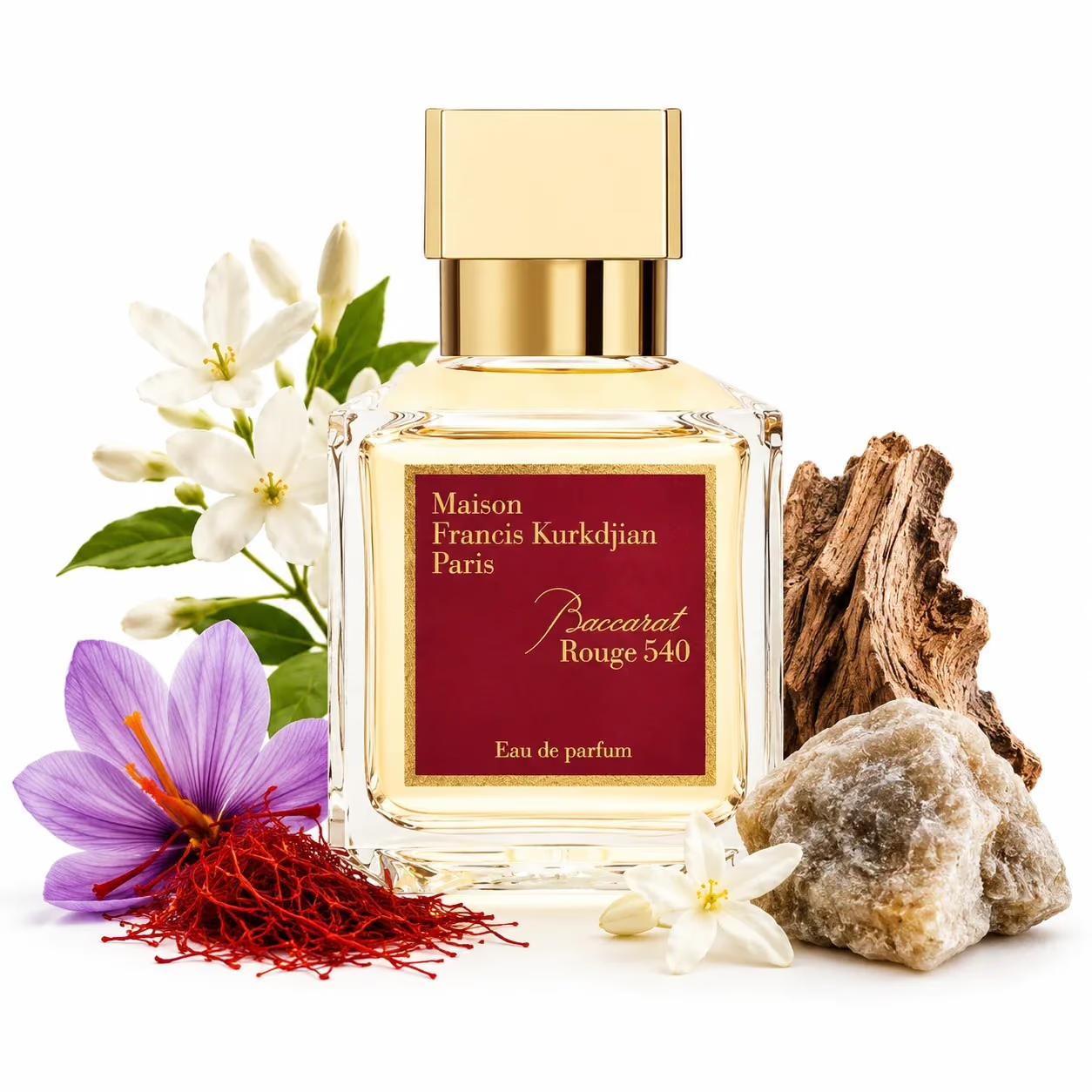
Francis Kurkdjian is the clearest illustration. He arrived in public at twenty-five with Jean Paul Gaultier Le Male in 1995 — lavender, vanilla and mint, a shape that dominated masculine perfumery for a decade. He later co-founded his own house and composed Baccarat Rouge 540 in 2015, made for the crystal maker Baccarat’s two hundred and fiftieth anniversary and built around a luminous saffron, jasmine and woody-amber accord that turned out to have extraordinary diffusion. One perfumer, two completely different commercial universes, both enormously influential. Whether it fills a room is a question of sillage rather than density, and that difference is unpacked in longevity and sillage explained.
Olivier Cresp is another career worth tracing. He composed Thierry Mugler Angel in 1992, the perfume that effectively invented the modern gourmand and made caramel, chocolate and patchouli a legitimate structure rather than a novelty. Two decades on, the coffee-and-vanilla architecture of YSL Black Opium — which he worked on with Nathalie Lorson, Marie Salamagne and Honorine Blanc — is a direct descendant of that idea. Collaboration is normal, incidentally: many contemporary perfumes list three or four perfumers, because a brief is refined by several hands before it ships.
Alberto Morillas has probably touched your life without your knowledge. CK One, Acqua di Giò, Bvlgari’s masculine line, and a long list of florals and musks across thirty years — his signature is a certain luminous cleanliness, a way of making white musk feel like light rather than laundry. He is also proof that a prolific perfumer is not a diluted one; volume is what the industry structure demands, and quality within it is a matter of individual discipline.
There are hundreds more. Jean-Claude Ellena wrote the transparent, minimal style at Hermès. Frank Voelkl made Le Labo Santal 33 into a scent people recognise in lifts. Dominique Ropion, Sophia Grojsman, Olivia Giacobetti, Christine Nagel — each has a recognisable hand, and reading a few of their names next to perfumes you already own is the fastest way to discover why your taste is more coherent than you thought.
The practical use of all this is simple. Perfume databases such as Fragrantica list the perfumer on most entries. Find three bottles you love, look up who made them, and see whether a name repeats. If it does, that perfumer’s other work is a far better recommendation engine than any bestseller list, because you are following a sensibility instead of a marketing budget.
It also changes how you read a launch. A house releasing its fifteenth flanker is a commercial decision. A house commissioning a perfumer with a distinct signature and letting them work is a creative one, and the difference is usually smellable. The tension between novelty and durability is the subject of old smells and new ones, and the vocabulary you need to describe a signature is in fragrance families explained.
None of this makes a perfume more or less authentic, and none of it should be confused with a shopping list. It is context — the kind that turns a shelf of interchangeable bottles into a set of authored objects, some of which you will admire without ever wanting to wear.
Knowing who wrote a scent will not tell you where to find the original of it. That still takes a conversation: message Ahmad or Khaled on WhatsApp, or start from the contact page.